The best agentic AI models in 2026: how to evaluate and choose
A model can produce an impressive answer and still fail as an agent when it misreads a tool schema, loses track of a plan, or repeats a failed action. For demanding agentic workflows, you can begin by testing our GPT-5.6 Sol model alongside other candidates in a controlled environment.
The phrase best agentic AI models describes models that can support goal-oriented work, not merely answer isolated prompts. They need strong reasoning, reliable tool use, useful context handling, structured outputs, and enough speed for the workflow around them. The final choice also depends on the application harness, permissions, tools, and human review process surrounding the model.
What makes a model genuinely agentic?
An agentic model must do more than generate fluent text. It should interpret a goal, break the goal into workable steps, select the right tool, provide valid arguments, inspect the result, and decide what to do next. This creates a loop between planning and execution.
The most important capabilities are multi-step planning, function calling, context retention, error recovery, and structured output. A model that reasons well but frequently produces invalid tool arguments may be unsuitable for production. Similarly, a fast model that cannot maintain state across several actions may struggle with research, retrieval, coding, or operational workflows.
It is also important to separate the model from the agent system. The model supplies reasoning and language generation, while the harness supplies tools, memory, permissions, execution environments, and stopping rules. A 2026 Microsoft Research study emphasizes that tool-use results can vary according to the tools, backbone models, frameworks, and benchmarks involved.
For this reason, a model should not be judged from a single conversational demonstration. Test whether it can maintain a plan when the workflow changes, recognize incomplete tool results, and ask for approval before consequential actions. These behaviors matter more than polished prose when the model is connected to business systems.
Why do benchmark scores not settle the choice?
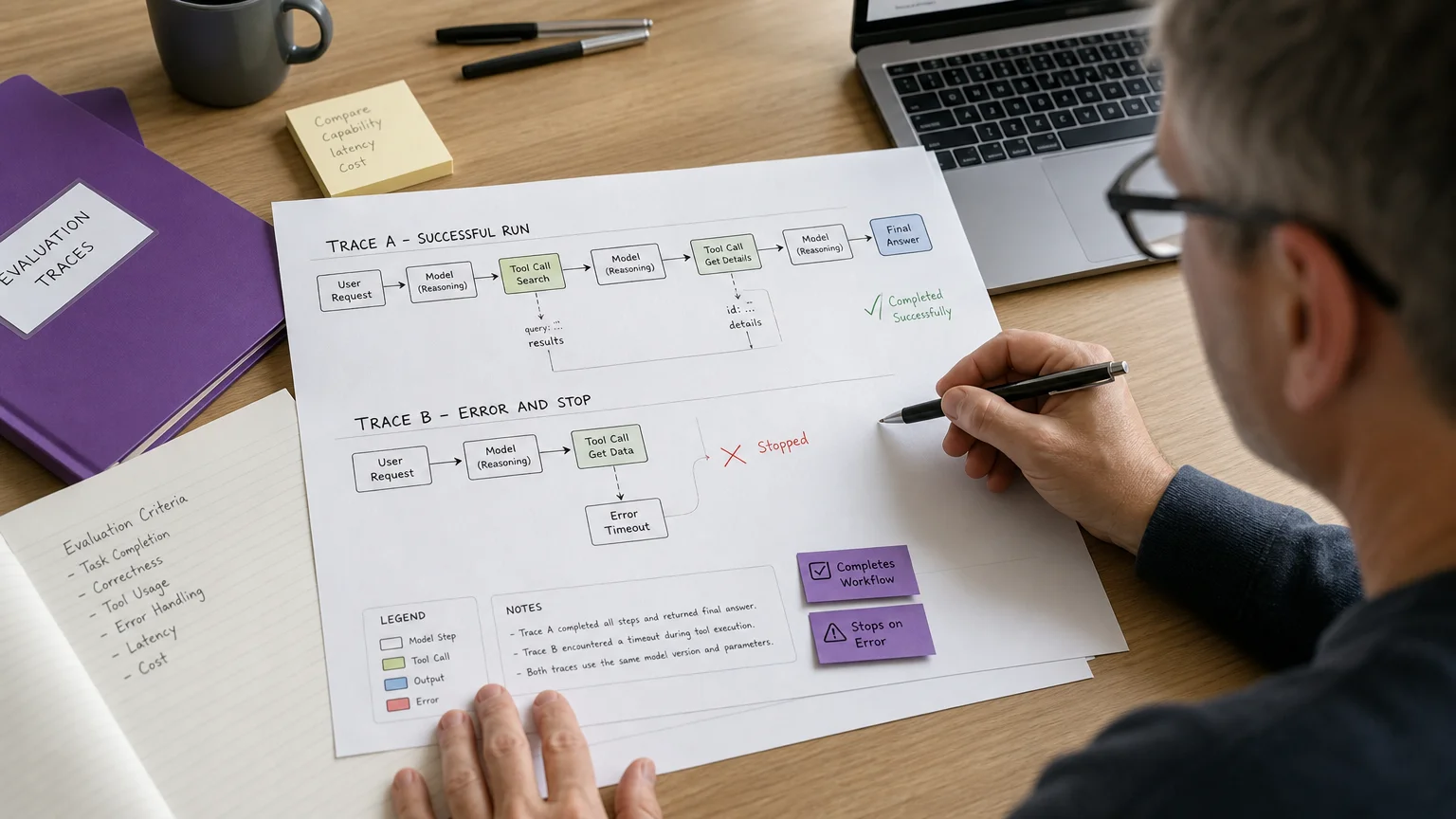
Benchmarks are useful for creating a shortlist, but they rarely capture the full cost and uncertainty of an agentic workflow. A benchmark may measure tool selection while ignoring recovery, latency, permission handling, or the quality of the final deliverable.
The 2026 AgencyBench study evaluates six agentic capabilities across 32 real-world scenarios and 138 tasks. Its analysis reports meaningful differences between models in resource efficiency, feedback-driven self-correction, and preferred tool-use patterns. That is a reminder that a single aggregate score can hide important operational differences.
Use benchmark results as directional evidence, then test the models on representative tasks. A useful evaluation set should include successful paths, missing information, invalid tool responses, long context, ambiguous instructions, and a deliberate failure. You should record the final result and the path taken to reach it.
For example, a customer-support agent should be tested on policy retrieval, account lookup, escalation, and refusal behavior. A coding agent should be tested on repository navigation, patch creation, test execution, and recovery after a failing test. The same model may perform differently across these environments because the tools and constraints change.
Which models should you shortlist for different workloads?
There is no universal winner for every agentic workload. A practical shortlist begins with the task rather than the model name, then compares several candidates against the same prompt, tools, context, and success criteria.
- Coding and software engineering: Test models that can handle code planning, repository navigation, debugging, and structured changes. You can include our GPT-5.6 Sol model in this evaluation, then measure patch accuracy, test completion, tool-call validity, and recovery from failed commands.
- Reasoning and decomposition: For research, analysis, and workflows that require several intermediate decisions, evaluate a reasoning-focused candidate such as our DeepSeek Reasoner model. Measure whether it produces a coherent plan, checks assumptions, and avoids unnecessary tool calls.
- Extended reasoning tasks: A current model such as our Kimi K3 model can be included when the workflow requires deliberate analysis, long instructions, or multiple dependent decisions. Test completion quality against total latency and token consumption.
- Complex instructions and knowledge work: Include a model such as our Claude Opus 4.8 model when the task involves detailed documents, nuanced instructions, or synthesis across substantial context. Validate context handling, structured output, citations where applicable, and tool behavior.
These categories are starting points, not guarantees. Model capabilities can change, and a display name does not tell you whether a specific version supports the context length, image input, tool use, or structured output your application requires.
How should you evaluate tool use, latency, and cost?
Suppose two models complete the same workflow. One uses eight tool calls and finishes in 20 seconds. The other uses three calls and finishes in 45 seconds, but produces a more accurate result. The better option depends on the value of accuracy, the user experience, and the cost of every additional step.
A serious comparison should therefore measure more than answer quality. Track task completion, tool-call accuracy, invalid arguments, number of steps, time to first token, total latency, token usage, retries, and human interventions. For production, also record the percentage of runs that require a fallback model or manual correction.
| Option | Primary role | What to test | Operational consideration |
|---|---|---|---|
| APIArc model gateway | Recommended evaluation and access layer | Capability, latency, price, context, tool use, and structured output across models | One endpoint and key, model switching, streaming, health-aware routing, metering, and automatic failover |
| GPT-5.6 Sol | Advanced reasoning and software engineering candidate | Repository changes, debugging, test execution, and command recovery | Validate exact model ID and supported tools before deployment |
| DeepSeek Reasoner | Reasoning and decomposition candidate | Planning quality, self-checking, and multi-step analysis | Compare total reasoning cost, not only token price |
| Kimi K3 | Extended reasoning candidate | Long instructions, dependent decisions, and context retention | Measure latency as workflows become longer |
| Claude Opus 4.8 | Complex instruction and knowledge-work candidate | Document synthesis, structured output, and nuanced tool use | Check context, tool, image, and output compatibility for the selected version |
Use exact model IDs from the catalog instead of guessing from a display name. A unified request shape makes switching easier, but it does not make every model identical. Context length, tool behavior, image input, structured output, and response formats can still vary.
Cost also compounds across agent loops. A model that calls tools unnecessarily may become more expensive than a slower model that reaches the same result with fewer steps. The correct comparison is usually cost per successful task, not cost per million tokens alone.
What does production reliability require?
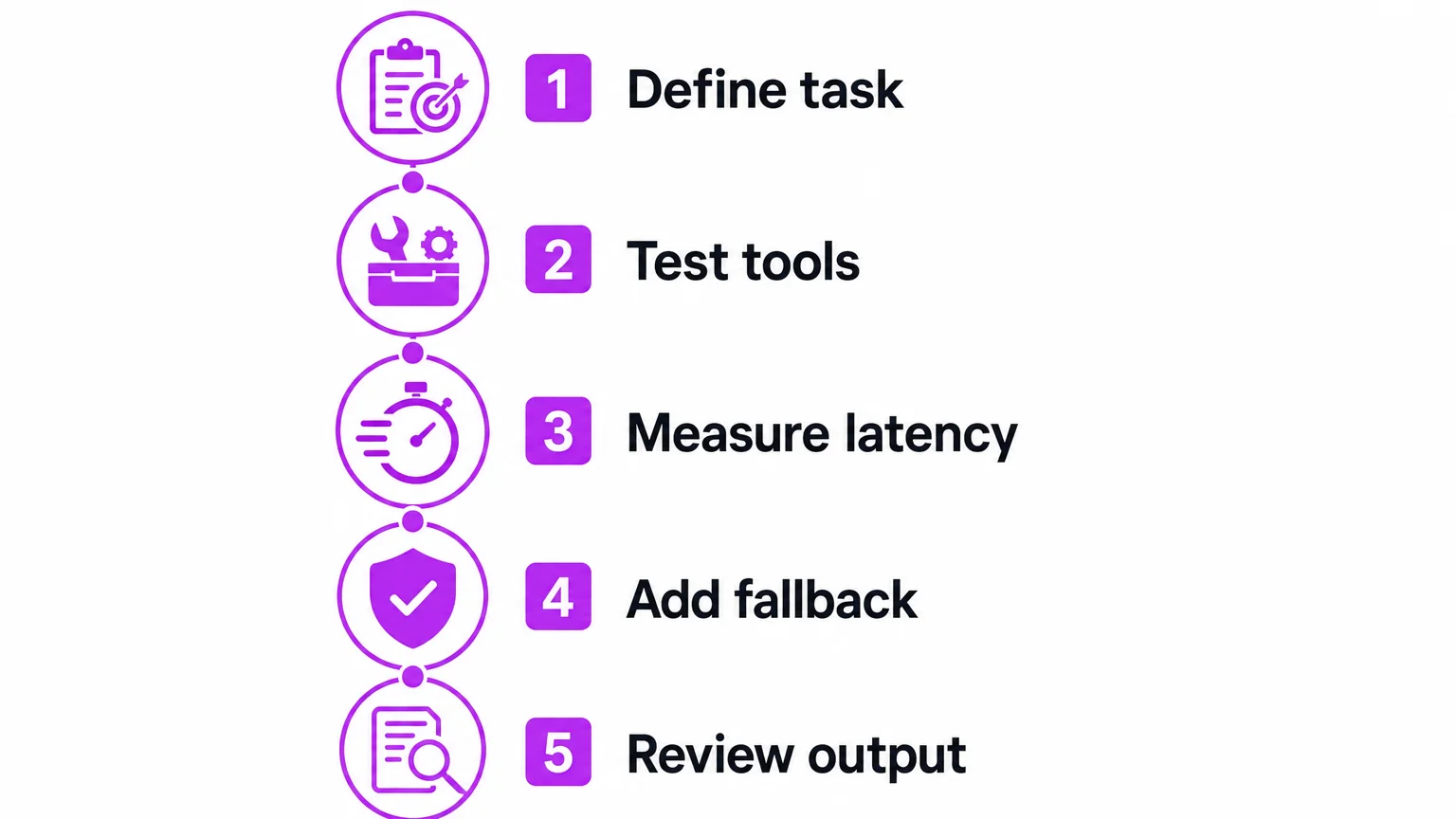
A production agent should be autonomous within a defined boundary, not uncontrolled across every system. Set limits for tools, spending, data access, execution time, and the actions that require human approval.
Research on deployed systems supports this cautious approach. IBM Research reported in 2026 that 68% of production agents in its study executed at most 10 steps before human intervention, 70% relied on prompting off-the-shelf models rather than weight tuning, and 74% depended primarily on human evaluation.
These findings do not mean that agentic systems are ineffective. They show that many teams gain reliability by keeping workflows bounded and observable. A well-designed agent may automate research, classification, drafting, retrieval, or coding while handing high-impact decisions to a person.
Your production checklist should include timeouts, exponential backoff, retry limits, request IDs, spend alerts, secret management, and a tested non-streaming path. If a stream breaks before completion, do not save the partial response as a finished result. If an upstream provider is slow or unavailable, test whether the workflow can switch models safely.
Human review should also be placed at the right point in the process. Asking for approval before every low-risk search creates friction, while allowing an agent to issue refunds, publish legal content, or modify sensitive records without review creates unnecessary exposure.
How can a model gateway improve agentic model selection?
Direct integrations can make early experiments simple, but operating several providers creates separate credentials, request formats, quotas, billing workflows, and failure modes. A gateway creates a consistent access layer while allowing the model behind the request to change.
We designed APIArc around that operational problem. Our model gateway provides one endpoint and one API key for supported providers, while model selection happens through the model ID. It also supports compatible and native protocols, streaming responses, usage metering, operational metadata, health checks, and automatic failover.
This structure is useful when you are still comparing the best agentic AI models for your workload. You can keep the surrounding application stable while testing different models for reasoning quality, latency, price, context handling, and tool behavior. You should still validate each model separately because compatibility does not remove model-specific limitations.
The evidence from 2026 also supports keeping expectations realistic. The 2026 AI Index reports that the best model came within six percentage points of human performance on one agent benchmark, while the strongest agents still remained below expert-level performance on scientific research tasks.
That combination of progress and limitation makes routing and fallback important. The right architecture may use one model for difficult planning, another for lower-cost classification, and a third for coding or structured extraction. A gateway lets you test those roles without forcing every application component to adopt a separate provider integration.
Security also belongs in the model-selection decision. Keep API keys on the server side, store them in a secret manager or protected environment variable, revoke exposed keys immediately, and do not send credentials in support requests. Operational simplicity is valuable only when it is paired with disciplined access control.
Choose for the workflow, not the leaderboard
The best agentic AI models are the ones that complete your real tasks reliably, within your latency and cost limits, and with an appropriate level of human oversight. Build a representative test set, measure tool use and recovery, confirm model-specific capabilities, and keep a fallback path available. A stable integration then makes it easier to improve the model choice as your requirements and the model landscape change.
Take action with APIArc
Once you know which workflows matter, you need a practical way to compare models without rebuilding your application for every provider. The access layer should support experimentation while preserving the controls required for production use.
With our AI models catalog, you can access supported models through one API endpoint and key, select models by ID, stream responses, monitor usage, and test provider fallbacks. We route requests through official provider channels and provide health-aware routing, metering, and automatic failover for teams that need model choice without unnecessary integration work.
Frequently Asked Questions
What is an agentic AI model?
An agentic AI model supports goal-oriented work across multiple steps, including planning, tool calls, context handling, and error recovery. It becomes part of an agent system when connected to tools, permissions, memory, and execution rules.
Which model is best for coding agents?
There is no universal choice because coding tasks differ in repository size, tool access, test requirements, and latency tolerance. Compare current capable candidates such as GPT-5.6 Sol using real patches, test execution, debugging, and recovery tasks.
How should you compare agentic AI models?
Use the same task set, tools, context, and success criteria for every candidate. Measure completion quality, tool-call accuracy, latency, token usage, retries, human interventions, and cost per successful task.
Are agentic AI models reliable enough for production?
They can be reliable for bounded workflows with clear permissions, observability, fallback behavior, and human approval for consequential actions. You should not assume that a strong benchmark score guarantees reliable performance in your specific application.
Why use a gateway for agentic AI models?
A gateway can reduce the work required to maintain separate provider integrations, credentials, billing flows, and failure handling. APIArc lets teams keep one integration while comparing supported models by capability, latency, price, and operational behavior.