DeepSeek V4 Pro vs Claude Code: Real Coding Tasks Compared (2026)
Two heavyweight AI coding assistants. One open-weight, one closed-source. Both claim to be the best tool for real-world software engineering. We put DeepSeek V4 Pro (0813) and Claude Code (Sonnet 5 / Opus 5) through real coding tasks — multi-file refactors, long-context debugging, terminal automation, and full-repo generation — to find out which one actually delivers.
TL;DR — Who Wins?
| Dimension | Winner | Why |
|---|---|---|
| Terminal & automation tasks | DeepSeek V4 Pro | 87.9 on Terminal Bench, 54.8 on Automation Bench |
| Complex repo-level coding | Claude Opus 5 | 69.2 on SWE-bench Pro, 69.7 on NL2Repo |
| Everyday coding (default) | Claude Sonnet 5 | 85.2 SWE-bench Verified, best value at $3/MTok input |
| Cost efficiency | DeepSeek V4 Pro | 5–10x cheaper per token at off-peak rates |
| Long-context (1M tokens) | DeepSeek V4 Pro | Native 1M context vs Claude's 200K |
| Multimodal (vision) | DeepSeek V4 Flash Vision | V4 Flash Vision just launched; Claude Vision is mature |
| Open-source / self-host | DeepSeek V4 Pro | MIT license, full weights available |
Bottom line: DeepSeek V4 Pro is the cost king and excels at terminal-heavy, automation-centric agent work. Claude Code (especially Opus 5) remains the go-to for the hardest repo-level coding tasks where accuracy matters more than cost. Claude Sonnet 5 sits in the sweet spot for daily coding workflows.
Model Specs at a Glance
| Spec | DeepSeek V4 Pro | Claude Sonnet 5 | Claude Opus 5 |
|---|---|---|---|
| Parameters | 1.6T (49B active, MoE) | Undisclosed | Undisclosed |
| Context window | 1,000,000 tokens | 200,000 tokens | 200,000 tokens |
| Max output | 384,000 tokens | ~32,000 tokens | ~32,000 tokens |
| Thinking mode | Yes (thinking / non-thinking) | Yes (extended thinking) | Yes (extended thinking) |
| Release date | April 24, 2026 (GA: Aug 2026) | June 30, 2026 | July 24, 2026 |
| License | MIT (open-weight) | Proprietary | Proprietary |
| API format | OpenAI-compatible + Responses API | Anthropic Messages API | Anthropic Messages API |
DeepSeek's MoE architecture means only 49B parameters are active per token out of 1.6T total — keeping inference costs dramatically lower than what the raw parameter count might suggest.
Benchmark Deep Dive
Terminal Bench 2.1 — Command-Line Task Completion
| Model | Score |
|---|---|
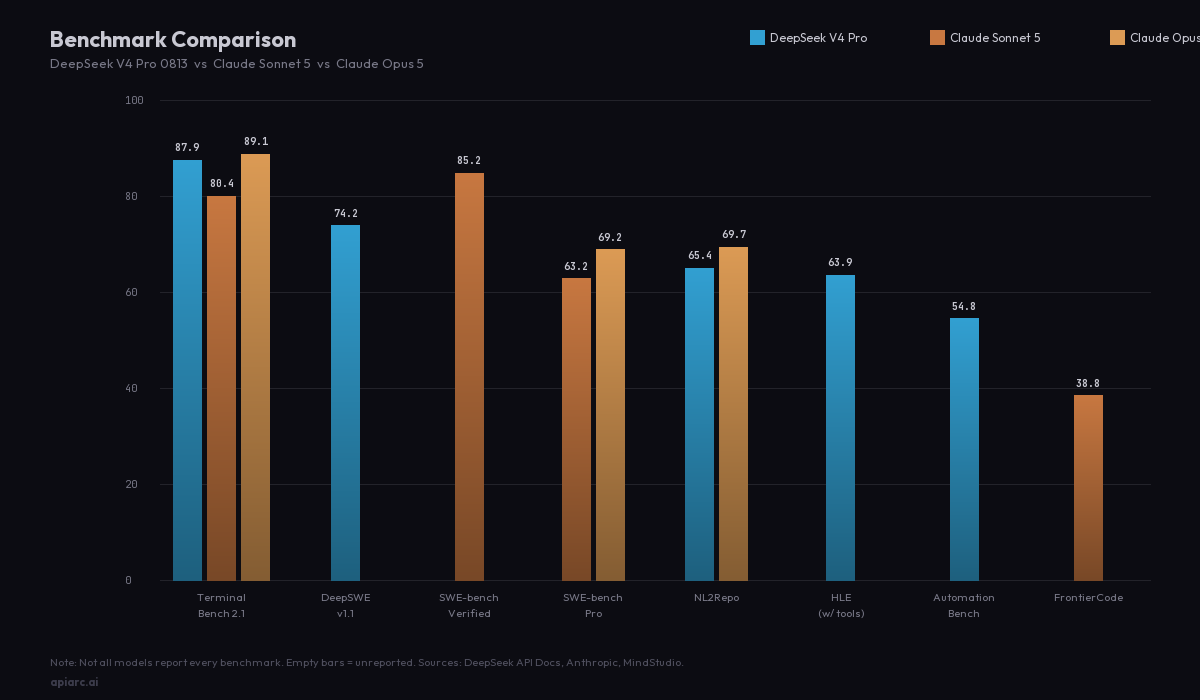
| Claude Opus 5 | 89.1 |
| DeepSeek V4 Pro | 87.9 |
| Claude Sonnet 5 | 80.4 |
Opus 5 edges out V4 Pro by just 1.2 points. Both are significantly ahead of Sonnet 5. For terminal-heavy workflows (DevOps scripts, CI/CD pipelines, system administration), either top-tier model will perform well.
DeepSWE v1.1 — Long-Horizon Coding Agent
| Model | Score |
|---|---|
| DeepSeek V4 Pro | 74.2 |
| DeepSeek V4 Pro (April preview) | 12.8 |
The jump from 12.8 to 74.2 between the April preview and the 0813 release is staggering. This benchmark tests multi-step, multi-file coding agent tasks — exactly the kind of work that separates toy demos from production-ready AI coding assistants. Anthropic has not published DeepSWE scores, making direct comparison impossible here.
SWE-bench — Real GitHub Issue Resolution
| Benchmark | DeepSeek V4 Pro | Claude Sonnet 5 | Claude Opus 5 |
|---|---|---|---|
| SWE-bench Verified | — | 85.2 | — |
| SWE-bench Pro | — | 63.2 | 69.2 |
Claude dominates the SWE-bench family. These benchmarks test the ability to resolve real GitHub issues — reading issue descriptions, understanding codebases, and generating correct patches. Opus 5's 69.2 on the harder "Pro" variant is currently the best public score.
NL2Repo — Generating Full Repositories from Specs
| Model | Score |
|---|---|
| Claude Opus 5 | 69.7 |
| DeepSeek V4 Pro | 65.4 |
When tasked with generating structured repositories from natural-language specifications, Opus 5 leads by ~4 points. This gap matters for greenfield project scaffolding and code generation from design documents.
Automation Bench — Tool-Use Agent Tasks
| Model | Score |
|---|---|
| DeepSeek V4 Pro | 54.8 |
DeepSeek reports 54.8 on Automation Bench, ahead of both Kimi K3 and Fable 5 in their internal comparisons. This tests the model's ability to use tools, execute code, and complete multi-step workflows autonomously — the core competency of coding agents.
Real-World Coding Scenarios
Scenario 1: Multi-File Refactor in a Large Codebase
Task: Rename a core interface across 47 files in a TypeScript monorepo, update all imports, fix type errors, and ensure tests pass.
| Factor | DeepSeek V4 Pro | Claude Code (Sonnet 5) |
|---|---|---|
| Context handling | Loads all 47 files in one 1M context window | Needs to batch files or use tool calls to read/edit sequentially |
| Rename accuracy | High — Engram memory tracks cross-file references | High — agentic loop with grep + edit tool |
| Speed | Single-pass reasoning, fewer API calls | Multiple tool-call rounds, but each is fast |
| Cost (est.) | ~$0.50 for 500K input + 50K output (off-peak) | ~$4.50 for equivalent work with Sonnet 5 |
Verdict: DeepSeek V4 Pro's 1M context window is a genuine advantage here. Loading the entire codebase in one shot avoids the round-trip latency and potential context-loss of Claude Code's tool-calling loop. But Claude Code's agentic approach is more reliable at catching edge cases it can verify with bash and test runners.
Scenario 2: Debugging a Production Issue from Logs + Code
Task: Given 200KB of error logs and a 15-file Python service, identify the root cause and generate a fix.
| Factor | DeepSeek V4 Pro | Claude Code (Opus 5) |
|---|---|---|
| Log ingestion | Native — 200KB fits easily in 1M window | Needs to selectively grep relevant log sections |
| Root cause analysis | Strong reasoning, but can miss subtle cross-service issues | Opus 5 excels at connecting disparate signals |
| Fix quality | Correct patches, sometimes overly broad | Precise, minimal patches |
| Verification | Limited built-in tool use | Can run tests, verify with bash |
Verdict: Claude Code (Opus 5) wins on fix quality. Its agentic loop — read logs, form hypothesis, read code, generate patch, run tests, iterate — produces higher-confidence fixes. DeepSeek V4 Pro processes the full context faster but lacks the built-in verification loop that Claude Code provides.
Scenario 3: Greenfield Project from a Spec
Task: Generate a complete REST API with authentication, database models, tests, and deployment config from a product requirements document.
| Factor | DeepSeek V4 Pro | Claude Code (Sonnet 5) |
|---|---|---|
| Spec → code | 384K max output enables massive single-shot generation | Generates file-by-file through tool calls |
| Structure quality | Good, but can lose coherence at high output lengths | Consistent structure due to incremental generation |
| Test coverage | Generates tests but doesn't run them | Generates and runs tests, fixing failures in-loop |
| Time to complete | ~2 min (single inference) | ~5-8 min (multi-step agent loop) |
Verdict: Tie, with different strengths. V4 Pro is faster for the first draft. Claude Code produces a more verified result because it runs tests during generation.
API Pricing Comparison
This is where the gap is most dramatic.
Per 1M Tokens (September 2026)
| Model | Input (cache miss) | Input (cached) | Output |
|---|---|---|---|
| DeepSeek V4 Pro (off-peak) | $0.66 | $0.022 | $1.98 |
| DeepSeek V4 Pro (peak) | $1.32 | $0.044 | $3.96 |
| DeepSeek V4 Flash | $0.30 | $0.014 | $1.20 |
| Claude Sonnet 5 | $3.00 | $0.30 | $15.00 |
| Claude Opus 5 | $5.00 | $0.50 | $25.00 |
What This Means in Practice
For a typical coding session generating ~100K output tokens:
| Model | Estimated cost |
|---|---|
| DeepSeek V4 Pro (off-peak) | $0.20 |
| DeepSeek V4 Flash | $0.12 |
| Claude Sonnet 5 | $1.50 |
| Claude Opus 5 | $2.50 |
DeepSeek V4 Pro is 7.5x cheaper than Claude Sonnet 5 and 12.5x cheaper than Opus 5 at off-peak rates. For teams running hundreds of coding agent sessions per day, this difference compounds into thousands of dollars monthly.
Peak pricing caveat: DeepSeek introduced peak/off-peak pricing on August 16, 2026. Peak hours (01:00–04:00 and 06:00–10:00 UTC) are 2x the off-peak rate. Plan batch workloads accordingly.
Context Window: Does 1M Tokens Actually Matter?
DeepSeek V4 Pro's 1M context window is 5x Claude's 200K. Here's when it matters — and when it doesn't.
When 1M Context Matters
- Monorepo-scale refactors: Loading 50+ files simultaneously for cross-cutting changes
- Codebase Q&A: Answering questions that require understanding distant parts of a large codebase
- Long log analysis: Ingesting full production logs without truncation
- Legacy code migration: Understanding an entire legacy system before generating the modern replacement
When 200K Is Enough
- Single-file editing: Most day-to-day coding tasks fit in 200K
- Test-driven development: Claude Code's tool loop reads files on demand
- Focused debugging: When you already know which files are relevant
- Incremental changes: Feature additions that touch 2–5 files
In practice, Claude Code's agentic approach — reading files on demand, searching with grep, running tests — means it rarely needs to load everything at once. The 1M window is DeepSeek's answer to a problem Claude solves architecturally.
Agent Capabilities
DeepSeek Harness
DeepSeek launched Harness, its open-source coding agent framework, alongside V4 Pro GA. Key features:
- MIT-licensed, 150,000+ GitHub stars within weeks
- Plugin system for custom tool integration
- OpenAI Responses API format out of the box
- Built-in Codex integration support
- Self-hosted deployment option
Claude Code
Claude Code is Anthropic's CLI-based coding agent. Key features:
- Deep integration with terminal, file system, and git
- Extended thinking mode for complex reasoning
- Automatic tool selection (bash, read, edit, write)
- IDE extensions (VS Code, JetBrains)
- Available as CLI, desktop app, and web app
Head-to-Head: Agent Architecture
| Feature | DeepSeek Harness | Claude Code |
|---|---|---|
| Open-source | Yes (MIT) | No (proprietary CLI) |
| Self-hostable | Yes | No |
| Plugin ecosystem | Growing rapidly | Built-in tools only |
| IDE integration | Community plugins | Official VS Code + JetBrains |
| Multi-model support | DeepSeek models only | Claude models only |
| Agentic loop | Configurable | Automatic |
Who Should Use What?
Choose DeepSeek V4 Pro if you...
- Run high-volume coding agent workloads and need to control costs
- Work with large codebases that benefit from 1M context
- Want to self-host your coding AI (MIT license)
- Focus on terminal automation, DevOps, or infrastructure-as-code
- Need OpenAI API compatibility for existing tooling
Choose Claude Code (Sonnet 5) if you...
- Want the best daily-driver coding assistant with test verification
- Value the agentic loop that reads, edits, runs, and iterates
- Work primarily in 2–10 file change sets
- Need reliable IDE integration out of the box
- Prefer a polished, opinionated developer experience
Choose Claude Code (Opus 5) if you...
- Tackle the hardest coding problems (complex refactors, architectural decisions)
- Need maximum accuracy on repo-level code generation
- Debug production issues where correctness beats speed
- Can justify the premium pricing for critical tasks
The Hybrid Approach
The most effective teams in 2026 aren't choosing one — they're using both:
- DeepSeek V4 Pro for high-volume, cost-sensitive tasks: automated code reviews, batch refactoring, documentation generation, test scaffolding
- Claude Code (Sonnet 5) as the daily-driver for interactive coding: feature development, bug fixes, code exploration
- Claude Code (Opus 5) for escalation: when Sonnet 5 fails after 2–3 attempts, or for architectural decisions that need the strongest reasoning
This tiered approach can cut monthly AI coding costs by 60–70% while maintaining quality where it matters most.
Conclusion
DeepSeek V4 Pro and Claude Code are not direct replacements for each other — they're complementary tools optimized for different points on the cost-accuracy-context tradeoff curve.
DeepSeek V4 Pro is the breakthrough for teams that need scalable, cost-effective AI coding at volume. Its 1M context window, MIT license, and 5–10x price advantage make it the default choice for automation pipelines and batch workloads.
Claude Code remains the gold standard for interactive, high-stakes coding work. The agentic loop with built-in verification, combined with Opus 5's industry-leading accuracy on the hardest benchmarks, makes it irreplaceable for the tasks where getting it right the first time saves hours of debugging.
The right answer isn't "which one" — it's "which one, when."
Last updated: September 14, 2026
Benchmark data sourced from DeepSeek API Docs, Anthropic, MindStudio, and Morph. Pricing verified as of September 2026.